Hornets in the news 📰
An overview of what the media report about the Asian hornet: incidents, figures and the debate about policy. We summarise what the source says and always link to the original report.
What you should know about the risk
Let us be honest about the proportions: serious incidents are rare. Most people who encounter a hornet are unharmed. But rare is not the same as impossible: on 1 September 2026 a man in Ninove became, as far as is known, the first person in Belgium to die from hornet stings. He was not allergic — there were simply too many of them.
But two things genuinely make the difference, and they recur in almost every report:
- The number of stings. A single sting is painful but harmless for most people. With dozens of stings at once, the sheer volume of venom is the problem — even if you are not allergic.
- A nest you did not see. The serious cases almost always happen because someone unknowingly gets too close to a nest: above a door, in a shed, inside a hedge. The colony then defends itself en masse.
So: never remove a nest yourself, not even with wasp spray. Keep your distance, keep children and pets away, and let someone with the right equipment handle it. If you are attacked anyway, walk away calmly rather than running, and protect your head and neck.
Call 112 immediately if there are many stings at once, stings to the mouth, throat or neck, or any breathlessness, dizziness or swelling of the face.
- Incident· Voorde (Ninove), East Flanders (Belgium)
Belgium's first known death from hornet stings: Eddy (60) did not survive dozens of stings
Eddy De Mulder (60) from Voorde near Ninove was fetching hay from his pony's stable on the evening of Thursday 27 August when dozens of Asian hornets emerged from a nest just above the stable door. He was stung dozens of times, including on his neck and throat. Swelling closed his airway and he went into cardiac arrest at the scene through lack of oxygen. He was resuscitated and taken to AZ Sint-Elisabeth (AZORG) in Aalst, where on Tuesday 1 September no brain activity was found. He died that same evening. Toxicologist Professor Jan Tytgat (KU Leuven) told Het Nieuwsblad that this is, as far as is known, the first time anyone in Belgium has died from hornet stings. One important detail: he was not allergic. The severity came from the sheer volume of venom from so many stings, not from an allergic reaction. A beekeeper who later removed the nest estimated it held around 5,000 hornets — exceptionally large. Hornet specialist Dominique Soete cautions that there may have been earlier deaths in Belgium that were never officially confirmed.
“The Asian hornets attacked in such huge numbers that the amount of venom was probably too much.”
Quoted in this article- Guy De Mulder — the victim's cousin
- Dominique Soete — hornet specialist
- prof. Jan Tytgat — toxicologist, KU Leuven
Source: VRT NWS · Het Nieuwsblad — Read the report at VRT NWS · Het Nieuwsblad - In the media· The Netherlands
Telegraaf: sharp rise in nests, beekeeping associations call for government action
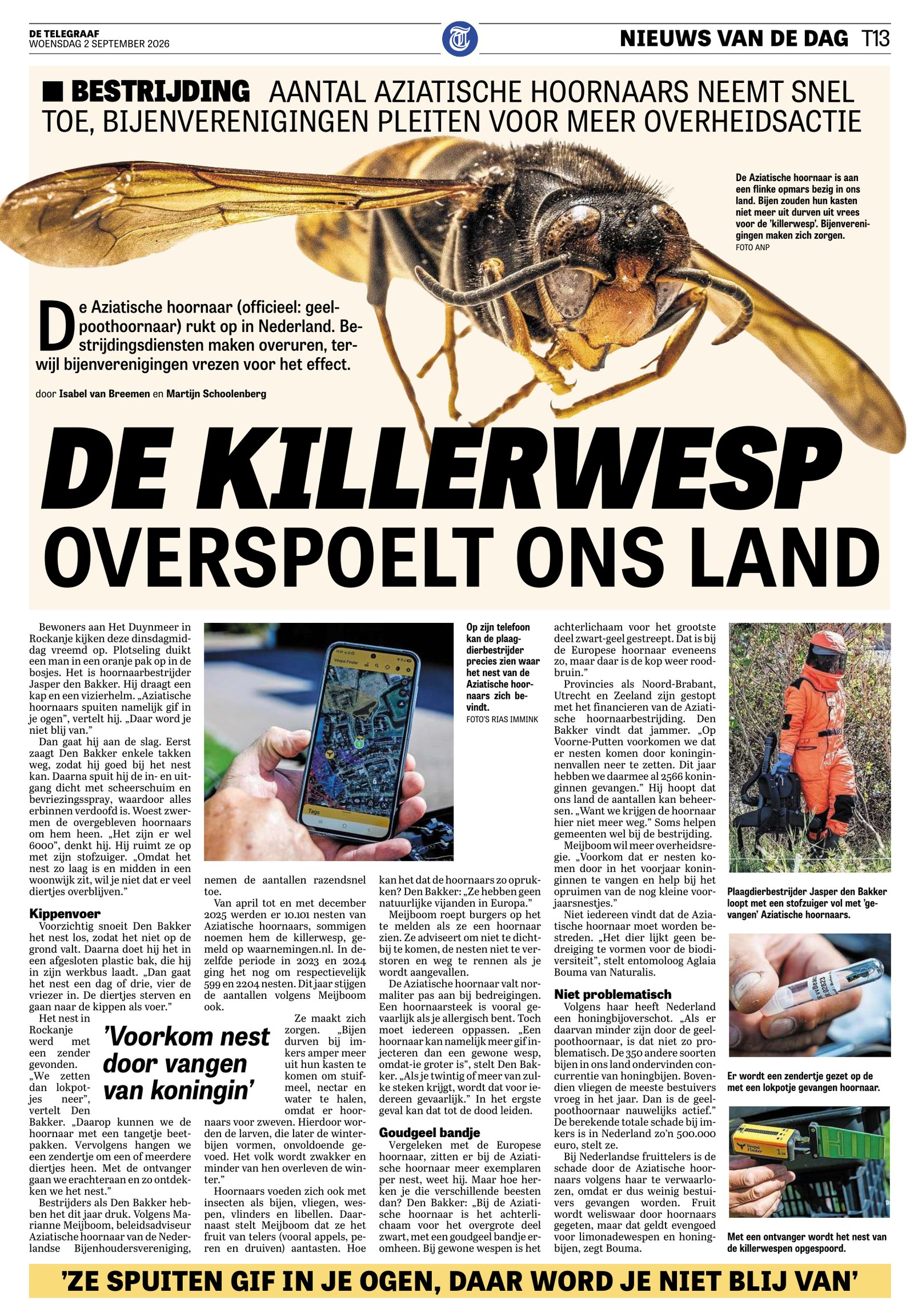
De Telegraaf ran a full-page article on the spread of the Asian hornet under the headline 'The killer wasp is flooding our country'. The figures are the striking part: between April and December 2025, 10,101 nests were reported on waarnemingen.nl, against 2,204 in the same period of 2024 and 599 in 2023. Marianne Meijboom, Asian hornet policy adviser at the Dutch Beekeepers Association, argues for more central government coordination: provinces including Noord-Brabant, Utrecht and Zeeland have stopped funding control work. Not everyone shares the alarm. Entomologist Aglaia Bouma of Naturalis says the species does not appear to threaten biodiversity, with damage to beekeepers estimated at around €500,000. On the risk to people the article is measured: a sting is mainly dangerous if you are allergic, but twenty or more stings become dangerous for anyone.
“If you get twenty or more of those stings, it becomes dangerous for anyone.”
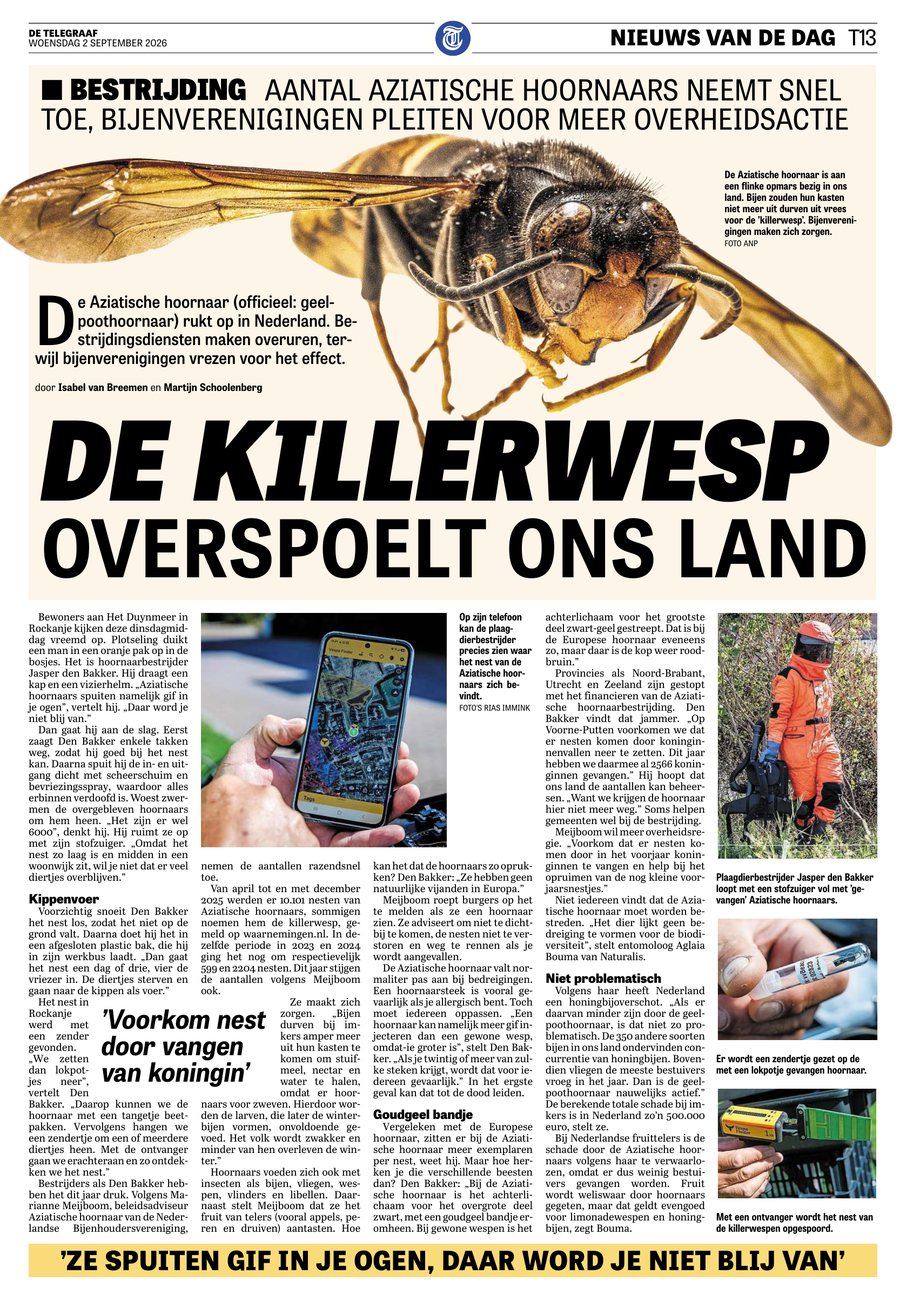
© De Telegraaf, 2 september 2026, p. T13 — tekst: Isabel van Breemen & Martijn Schoolenberg · foto: ANP · View the original page Quoted in this article- Jasper den Bakker — pest controller, Rockanje
- Marianne Meijboom — Asian hornet policy adviser, Dutch Beekeepers Association
- Aglaia Bouma — entomologist, Naturalis
- Isabel van Breemen & Martijn Schoolenberg — authors of the article
Source: De Telegraaf — Print edition, Wednesday 2 September 2026, page T13. By Isabel van Breemen and Martijn Schoolenberg.
This page is a selection of reports from other media. The facts are as the named source reports them; we do not carry out our own investigation. Something wrong, or a report missing? Let us know.
Seen a nest near you?
Send a photo via WhatsApp. We'll assess free of charge whether it is the Asian hornet and tell you what to do next. Do not approach it yourself.